Weeping Willow
Salix alba tristis
The Golden Cascade: Salix alba 'Tristis' (Golden Weeping Willow)
The Snapshot
Common Name: Golden Weeping Willow
Scientific Name: Salix alba 'Tristis' (often sold as Salix x sepulcralis 'Chrysocoma')
Origin: A hybrid involving the European White Willow.
Hardiness: Zones 4 – 9 (Extremely hardy across all of NJ).
The "Vibe": Romantic, dramatic, and sweeping; the "poet’s tree."
Why It’s a Landscape Legend
Year-Round Gold: The "Tristis" variety is prized for its golden-yellow twigs. In the winter, when most trees look grey and lifeless, a Weeping Willow glows like a beacon of sunshine against the snow or a leaden NJ sky.
Unbeatable Motion: The long, slender branches (pendulous) can reach all the way to the ground. They dance in the wind, creating a "waterfall" effect that adds movement to a static garden.
The First Sign of Spring: Willows are among the very first trees to "wake up." Their golden branches begin to haze over with bright, chartreuse-green leaves in late March, weeks before the Oaks and Maples.
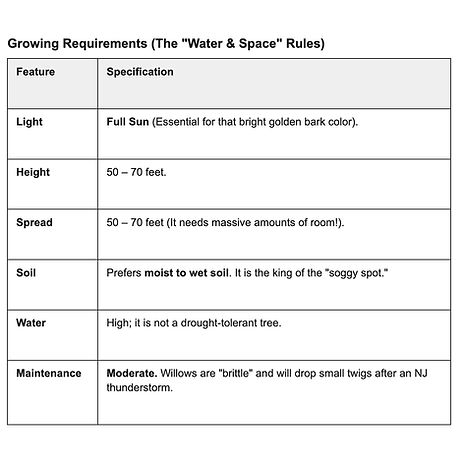
Nature’s Sponge: If you have a low spot in your yard that is always soggy or a pond bank that is eroding, the Willow is your best friend. It loves water and has a massive root system that drinks up moisture and holds soil in place.
Stories from the Garden
"We have a small stream at the back of our property in Basking Ridge that used to overflow every spring. We planted a Golden Weeping Willow five years ago, and not only has it stabilized the bank, but it's become the centerpiece of our yard. In the winter, the yellow branches look incredible against the evergreens. Yes, I have to pick up small twigs before I mow, but for that view? It’s 100% worth it."
— Jim D., Zone 6 Gardener (Basking Ridge, NJ)
Designer Tips: Where to Plant
The "Water’s Edge": There is no more iconic pairing than a Weeping Willow and a pond. The reflection of the golden branches in the water is pure magic.
The Large-Scale Specimen: Only plant this if you have a large property. It is a "cathedral" tree that needs space to spread its wide, arching canopy.
The Distant Focal Point: Because of its bright color and massive size, it is a great tree to plant at the far end of a field or meadow to draw the eye.
Designer Pro-Tip: Never plant a Weeping Willow near your house, septic system, or underground water lines. Their roots are "water-seekers" and are famous for finding even the smallest crack in a pipe. Give them at least 50 feet of distance from any underground utilities.
Ecosystem & Wildlife Impact
Pollinator Early-Start: Willows produce catkins (flowers) very early in the spring, providing a critical first meal for Honeybees and Native Bees.
Butterfly Host: It is a major host plant for several stunning butterflies, including the Viceroy and the Mourning Cloak.
Nesting Haven: The dense "curtain" of branches provides excellent cover for Yellow Warblers and other songbirds.