Okame Cherry
Prunus 'Okame'
The First Blush: Prunus 'Okame' (Okame Cherry)
The Snapshot
Common Name: Okame Cherry
Scientific Name: Prunus x 'Okame' (P. incisa x P. campanulata)
Origin: A hybrid developed in England by Captain Collingwood Ingram, the world's foremost cherry expert.
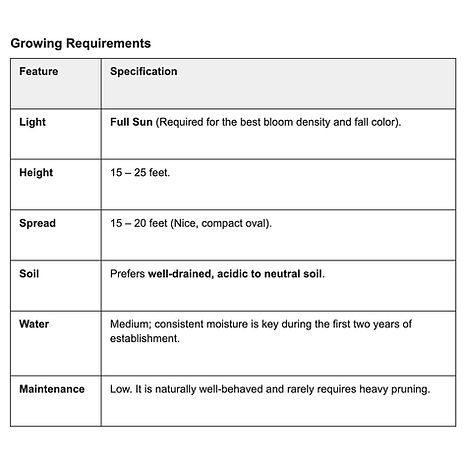
Hardiness: Zones 5 – 9 (Very adaptable and surprisingly cold-hardy).
The "Vibe": Delicate, airy, and hopeful; the "pink mist" of the early spring.
Why It’s a Garden Treasure
The Earliest Show: In New Jersey, 'Okame' usually blooms in late March. It is the bridge between winter and spring, offering a soft, rosy-pink cloud when the rest of the landscape is still brown.
Intricate Blooms: Unlike the heavy "pompoms" of 'Kanzan', 'Okame' has small, single-petaled, bell-shaped flowers with deep red calyxes. The result is a more delicate, elegant appearance.
The Bark & Form: It develops beautiful, polished reddish-brown bark with prominent lenticels (pores). It naturally grows into a tidy, upright-oval shape, making it perfect for smaller suburban lots.
Unbeatable Fall Color: Many ornamental cherries have lackluster fall foliage, but 'Okame' turns a brilliant orange-red to bronze in October, giving it a true second season of interest.
Designer Tips: Where to Plant
The "Morning View" Tree: Plant it where you can see it from your breakfast nook or kitchen window. It is a fantastic mood-booster during those chilly, grey March mornings.
The Entryway Accent: Its upright-oval habit is perfect for framing a front door or flanking a driveway without overgrowing the space.
Underplanting Brilliance: Since it blooms so early, plant a carpet of blue Scilla or purple Crocuses underneath. The contrast of the pink clouds above and the blue/purple carpet below is world-class.
Designer Pro-Tip: Because 'Okame' blooms so early, the flowers can occasionally be nipped by a late New Jersey frost. To protect your show, plant it in a slightly protected spot (like the south side of a house) or a spot that isn't a "frost pocket" at the bottom of a hill. Even if a frost hits, the red calyxes often remain, maintaining a hint of color!
Ecosystem & Wildlife Impact
Early Nectar Source: 'Okame' is a vital lifeline for early-emerging bees and overwintering pollinators who find very few other food sources in March.
Hummingbird Magnet: If the weather is warm enough for early-returning hummingbirds, they will head straight for the tubular, bell-shaped flowers.
Bird Friendly: The fine branching provides excellent cover for small songbirds like Chickadees and Titmouse.