Daylily
Hemerocallis
The Daily Wonder: Unstoppable Resilience with Hemerocallis
The Snapshot
Common Name: Daylily
Scientific Name: Hemerocallis spp. (Greek for "Beauty for a Day")
Origin: Asia (Central and Eastern)
Hardiness: Zones 3 – 9 (Bulletproof in almost any climate)
The "Vibe": Robust, cheerful, and incredibly diverse; the "all-rounder" of the flower world.
Why We Love It
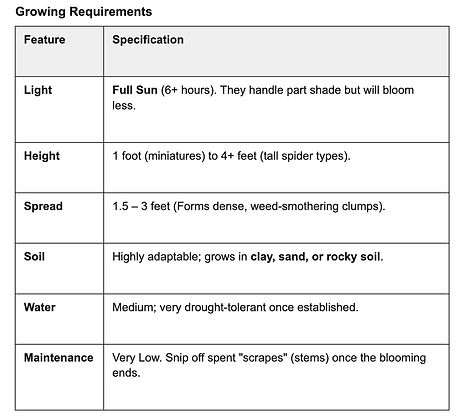
The Daylily is the ultimate "low-demand, high-reward" plant. While each individual flower lasts only 24 hours, a mature clump can produce hundreds of buds, ensuring a continuous show for weeks. They are famous for their indestructible nature: they handle drought, flooding, salt spray, poor soil, and neglect with a smile. Their fountain-like, arching foliage stays green and lush all season, providing a clean texture even when the plant isn't in bloom.
Ecosystem & Wildlife Impact
Early Morning Nectar: Provides a quick, high-energy nectar source for hummingbirds and butterflies as they start their day.
Bee Support: Many native bees crawl deep into the trumpets to gather pollen.
Soil Stabilizer: Their thick, tuberous roots are excellent for erosion control on steep banks or hillsides.
Pollinator Buffet: Night-blooming varieties are a favorite for sphinx moths.
Designer Tips: Where to Plant
The "Hellstrip" Hero: Because they are so salt and heat tolerant, they are the perfect plant for the strip of land between a sidewalk and the road.
The "Living Mulch" Border: Plant them in a row. Their dense, arching leaves shade the ground so thoroughly that weeds simply cannot grow underneath them.
Mass Naturalizing: Use the orange or yellow varieties to fill a large, open bank or hillside for a maintenance-free "sea of color."
Designer Pro-Tip: Look for "Reblooming" varieties like the famous 'Stella de Oro' or 'Pardon Me'. While standard daylilies have one big "show," rebloomers will send up new flower stalks in waves throughout the entire summer, giving you color from June through September.
Stories from the Garden
"I have a spot by my mailbox where the snowplow dumps salt and ice every winter. I tried five different plants there and they all died. Three years ago, I put in some Daylilies, and they have been flourishing ever since. They are the toughest plants I’ve ever met."
— Gary T., Zone 5 Gardener
A Growing Story: The Passing of the Torch
A customer told us she has a patch of "Lemon Lilies" (H. lilioasphodelus) that her great-grandmother brought over as a root cutting. Every time she sees them bloom in June, she smells the same scent her grandmother’s garden had 50 years ago. It’s a plant that carries history in its roots.